
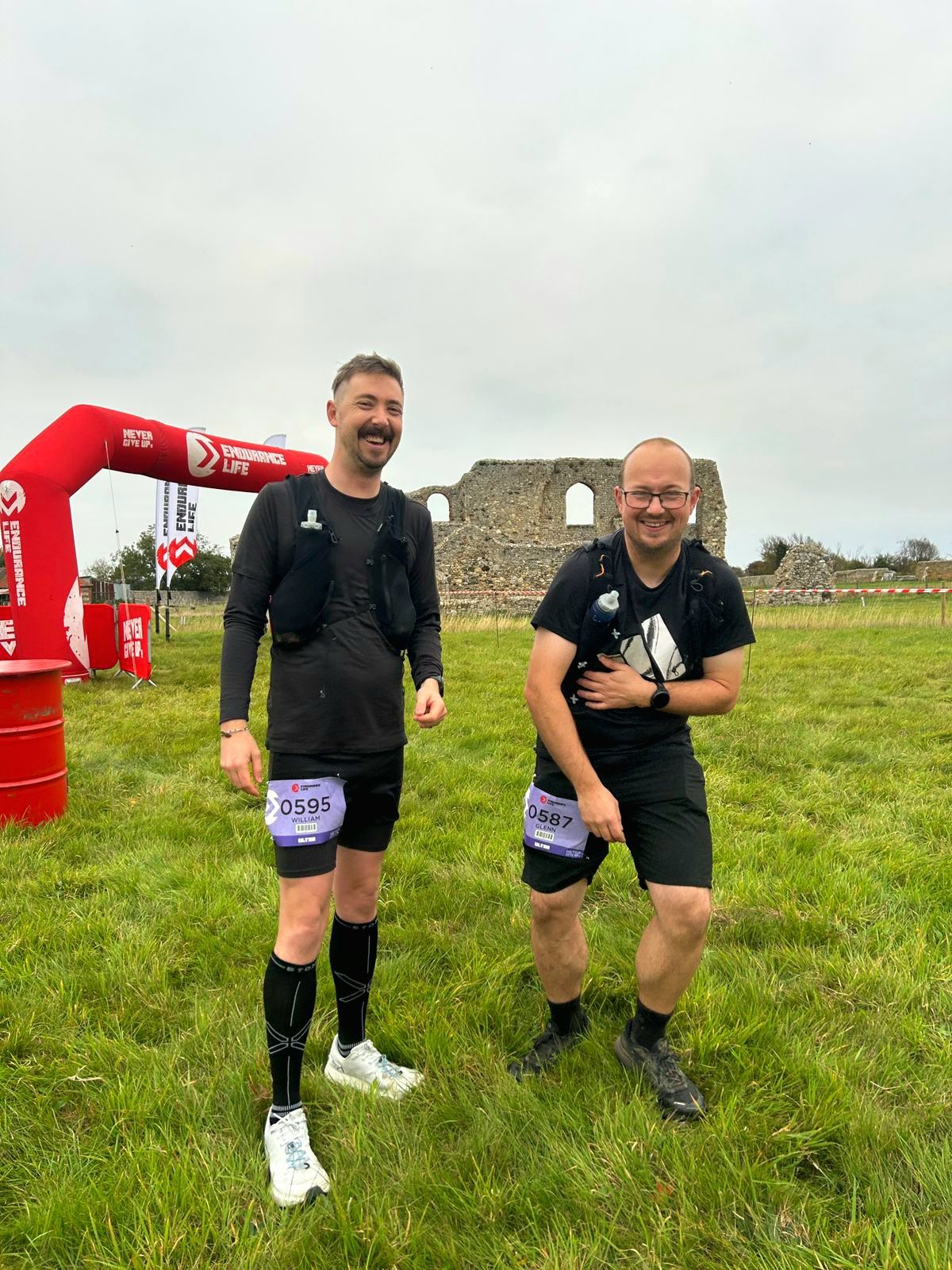
The night before the race, Will mocked my DNF back in January and reminded me how he’d run every race faster than me. It was all in jest, but his light-hearted teasing carried a sting of truth. Will knew how to run an ultramarathon. Yet, I highlighted another reality, that at some point, I’ll finish before him. How ironic would it be if, after all his boastful mockery, it happened tomorrow? I’d never let him live it down. With the benefit of fortunate hindsight, I’m lucky it wasn’t a competition, but a tale of two friends with two different targets.
The Race
With it being almost a year on from Devon, we’d signed up for a hilly Ultramarathon in North Cornwall in January 2026. However, if South Devon were hilly, North Cornwall’s elevation would make it feel timid, so we set out in search of an easier course, unsure if such a thing existed in the Ultramarathon world. This led us to Suffolk.
It was organised by the same company that organised Devon and Cornwall, Endurance Life. Like all EnduranceLife courses, they offer several routes, including 10k, half-marathon, and marathon options. For the ultra-marathon, we’d run the whole marathon route and then one lap of the 10k route.
Starting in Dunwich, the course took us along the Suffolk coast and through the surrounding heaths and marshlands. Thankfully, it had no more than 300m of elevation, which, when spread over 52km, felt like a perfectly flat course. However, it didn’t take me long to learn that running over soft sand would raise my heart rate to disproportionately high levels.
How I Planned to Run My Ultranarathon
Back in May, I ran 70km in 12 hours during a time-challenge race called Farmageddon. This left me with a profound sense of confidence. In reality, having to run an ultramarathon with cut-off times and clearly defined finish times is a whole different beast. I’m not downplaying Farmageddon: the achievement, the thrill, the crawling for one last lap, but this race felt like another attempt at finishing my first true ultramarathon since my DNF in January.
My training runs gave me hope, but most fell short of my intended distance targets. A lot of the time, I found myself cramping around the 28km and calling time on my run. I blamed poor hydration in the days before my training run. Since I wasn’t as busy on Fridays, I’d often drink less water at work on Fridays, and it seemed to catch up with me during those long runs.
My weekly running volume also dropped radically compared to my South Devon preparations. I convinced myself that three runs a week would be enough, but as race day approached, I didn’t feel ready. Injury prevention was my main excuse, but in truth, I sacrificed too much aerobic training. This, at least according to my Garmin, caused my VO₂ max to stagnate. Motivation also wavered, though I hope that running home from work will help me rebuild consistency ahead of January.
The biggest blow came the weekend before the race, due to illness. I never felt like I fully recovered, and my Garmin sleep scores remained stubbornly low. Work was hectic, too, since we were short-staffed. Murphy’s Law struck hard. Everything that could go wrong, did. How was I supposed to run an ultramarathon with these limited preparations?
It seemed logical, then, that this race could offer me only one target: to finish. That alone meant victory. It wouldn’t be the first time I’d covered the distance, but it would be the first time I’d completed a proper, race-formatted ultramarathon. If I finished
A Different Run: Will’s Ultramarathon Target
Will and I have an incredible friendship because of our similarities. But when it comes to pre-race prep, our approaches to running are quite different. He meticulously organises his nutrition as though a single misstep would result in failure. It’s not that I don’t take it seriously, but I’ve only ever trained with the same nutritional strategy, making my pre-race prep feel more laid-back.
I’ve only trained with gels, so sweets and high-carb snacks are often an afterthought. Will lays out his entire nutritional strategy in advance. For this race, he planned to carry two bottles: one filled with water and the other with Tailwind, a carbohydrate and electrolyte mix, while I only had water. Will’s more refined fuelling strategy also involved carrying less and meeting his Storm, his wife, at checkpoints to trade his empty bottles for pre-filled ones.
Nutritionally speaking, Will was thoroughly prepared. Yet, his training lacked the consistency of mine. Even though my runs may have felt as though I hadn’t gone as far for as long as I should, Will’s job left him with little time to train. His job leading photographic tours across remote locations such as Uganda, the Himalayas, and Kenya might be rewarding, but it involves long days, entertaining guests, and leaving little room for productive training. When he was home in England, he ran a lot, but like me, he never felt fully prepared to run another ultramarathon.
Yet, with this being Will’s fourth ultramarathon in just over a year, he still maintained an air of confidence. His training may have felt undertrained, but the flattish course offered him a shot at smashing his 50k personal best. If my target was to finish, Will was setting out to beat himself.
A Tale of Two Paces: Two Friends Run an Ultramarathon
Before Devon, I felt prepared, confident, and excited. It was a new feeling. My first ever marathon saw me still recovering from a chest infection, leaving me predicting failure in any target I set myself. Illness, and the same thoughts befell this race.
We arrived at the start with all the nutrition we’d need, and I got my ritualistic pre-race coffee. As we organised our running vests and nutrition, it soon became apparent that I’d forgotten my water. Fortunately, the ever-prepared Will had his spare, tailwind-free bottle, which he kindly lent me, and Storm agreed to bring my water to the next checkpoint.
Fortunately, that’s all that would go catastrophically wrong. The weather remained dry, but the coastal air carried a stiff chill. Will and I began the race together, but we’d soon separate as he settled into his relatively quick PB-chasing pace and I slowed down trying to recapture my earlier enjoyment as I slogged towards the next stage, with a plan to strategically Jeff my way through it.
Jeffing – A run-walk strategy popularised by Olympian Jeff Galloway. It involves alternating run-walk intervals to see how a race. The idea is to conserve energy and reduce fatigue, which often leads to faster finishing time.
The first 20km flew by. I found the whole thing rather enjoyable. Minor inclines and rolling surfaces made me wish I’d brought my mountain bike instead. But those daydreams faded when I hit the marshlands and sandy beaches. Cycling over that terrain would’ve proved impossible.
As I approached the half-marathon mark, Will messaged to ask how I was getting on. My response told its own story: “I’m running slow but actually enjoying the route.” He was 6km ahead of me, and his quickened pace had declined dramatically – his words, not mine. Maybe, just maybe, I could catch up. I still had a fair bit of energy left.
That flicker of hope wouldn’t last long. Running slowly also taxes the body. Will ran fast, and his body forced him to slow down. I ran slowly, but my body kept me going at that pace, unable to go any quicker as I tired.
I met Storm at the 39km checkpoint. She told me he was almost around again, finishing the extra 10k loop we’d need to run to complete the ultra. I took this in my stride, determined to believe she’d exaggerated how close he was. The thought of Will overtaking me and finishing the ultramarathon before I’d completed the marathon stage was incomprehensible to me, even at my slow pace.
Then, as I approached the last mile and a half of the race, someone tapped me on the shoulder. I jumped. Will was sprinting with a burst of speed that contradicted every message he’d sent me. He was going to finish the ultra before I finished the marathon.
And yet, I didn’t care. In fact, any enjoyment I lost from the anxiety of that very thing happening evaporated. I went back to begging for the finish line while endlessly searching for the same enjoyment I held for the course earlier.
How to Run an Ultramarathon: Lessons from the Trail
1 – Look Forward
I fell over in the marshes. If anything proved this race differed from Devon, it was that moment. I could’ve fallen in any direction and ended up drenched in swamp-like water. Instead, I landed on the narrow, overgrown path ahead. The only damage was a muddy pair of hands, easily fixed with a quick rinse and some hand sanitiser at the first checkpoint, where I also picked up my water bottles.
2 – Don’t Run on Sand
8 km into the race, I found myself on a 2.5km stretch of beach. The sand was soft in places where it hadn’t rained much over the past week, making it easier to navigate than the stony beaches we’d run along later. Still, I found myself in a mini competition with another runner who had decided to walk the entire length of the beach. I ran past him, walked, then ran again. And yet, while walking, he left the beach before me. Maybe I could’ve saved some energy if I’d just walked too.
3 – Download Everything Before Setting Off
Before every long run and race, I set up my playlist queue with a few songs and podcasts, which would hopefully last the entire planned time. What I hadn’t accounted for was those podcasts not loading while I was stuck out in the middle of nowhere. There’s nothing like the sound of the gentle wind over calm water to highlight the intensity of your pounding heart and heavy breathing.
4 – But Most Importantly, Have Fun
I’m guilty of this, too. We get so caught up in cut-offs and finishing races with pre-conceived goals in mind that we forget that we’re not professional athletes. We’re just ordinary people who’ve fallen in love with a sport. It’s a hobby, and one that should fill us with joy, not pressure. I set out to enjoy this race because I felt like finishing was all I could hope for following a short illness. Who knows what crazy targets I’d have set myself if I hadn’t been kept awake all week by a high temperature and a blocked nose. And yet, it turned out to be the best race I’ve run to date in terms of enjoyment. Don’t forget to have fun. No matter the outcome, you’ll still get the same medal.
Oh, and always remember your water.
Leave a ReplyCancel reply