
I’d always considered a DNF a failure. When everyone else saw a time after their name on a results page, some losers saw the first letters of a three-word phrase: Did Not Finish. Big, bold letters highlighted my inability to finish a race I’d committed to, trained for, and given all have. Three letters rendered you a failure. Everyone knows that, right? The very thought terrified me.
Those three letters spurred me on. They made me anxious enough to push my body to its limits in training. My training became consistent. I lost a show. I ran a marathon PB. I put everything into training hard because I thought a DNF would kill me.
The Race I Didn’t Want to DNF
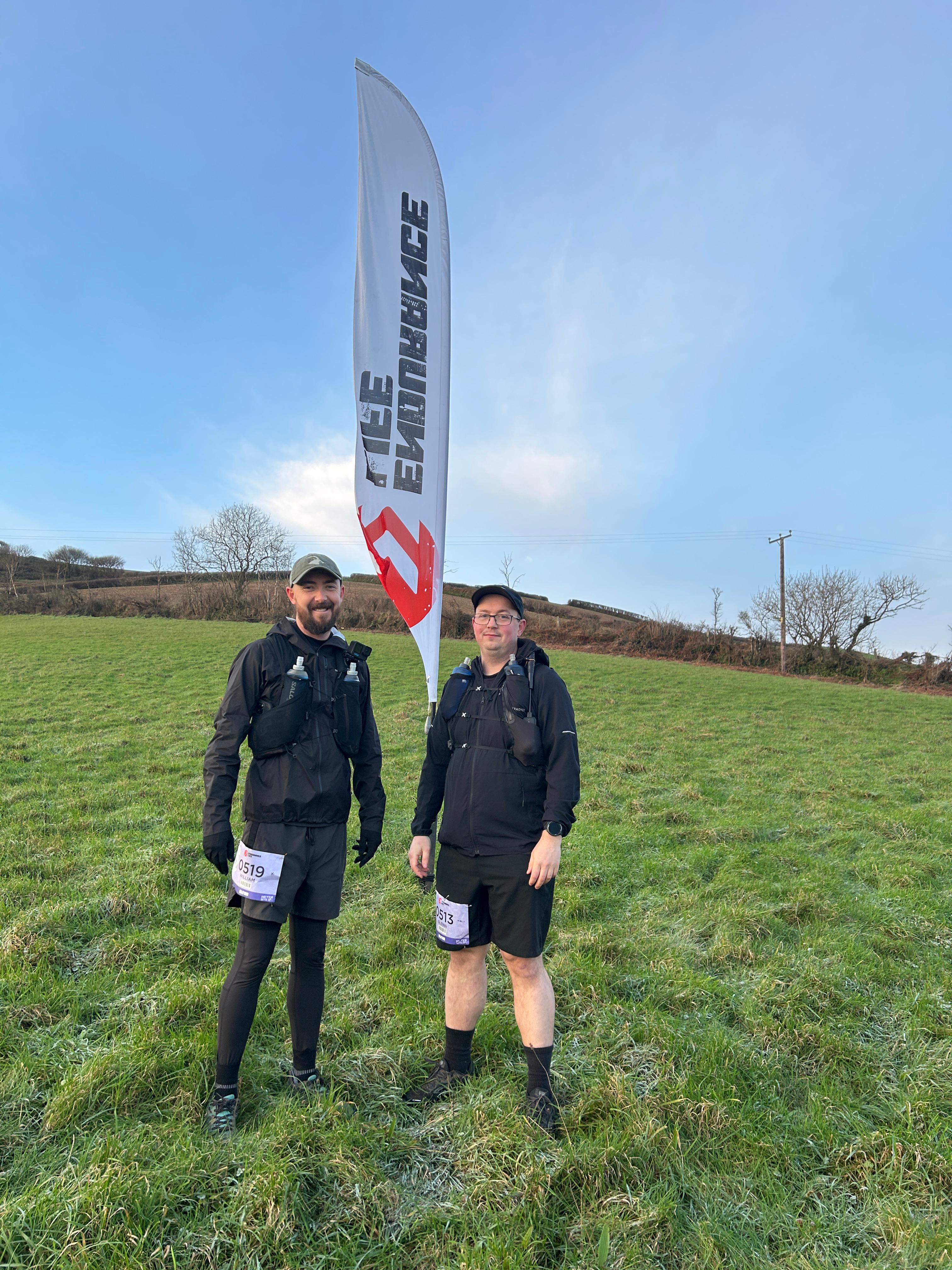
If you’ve watched any of our videos on the Run Unscripted YouTube channel, you’d know that Will usually comes up with all the good ideas. Yet, this time, it was all me. I wanted to run a race in January, around the same time I started running, to mark my first anniversary of falling in love with the sport. Although the exact dates were approximately three weeks apart, both events took place in January, a year apart.
Endurance Life organised the race. It was on the south coast of Devon, a region known for its rugged and hilly terrain, but I had no idea what kind of terrain lay in store. Over a 54-km course, 1500m of elevation gain was set against a cold backdrop of potential rain along the southwestern coast. Could there be a more challenging course to run my first ultramarathon to wrap up my first year of running? Will agreed to join me, probably because his ego refused to let him say what he really wanted to say. Like most of his YouTube ideas, it was a silly idea.
Two Shorter Races
The first race was a 23km slog through the Kent Downs, which saw me run slower than I might typically have managed on flatter roads. However, wet and muddy trails with 500 metres of elevation were bound to slow me down. When I crossed the finish line, my quads were on fire. If I were to run the big one in January, I would need to strengthen my legs, especially if I wanted to conquer all those hills.
A month later, similar conditions saw me running a 25km race along the length of Epping Forest. It was 25km of trails, albeit with half the elevation compared to Kent. I struggled to keep my heart rate low and felt like I was battling to maintain my pace. However, the downhill stretches helped me find real success. I’d smashed my half-marathon PB time in muddy conditions with over 200m of elevation gain and heavier trail shoes. I was heading into my first ultramarathon training block full of confidence and experience.
The Fear of a DNF Training Plan
I used Runna to help me plan my anti-DNF training. I selected four days of running per week, which meant I committed to an extra day of running than I would typically do. But the long distances struck me first. I knew training for an ultramarathon would be difficult, but I didn’t expect to run a marathon distance the week before Christmas. Before this training block, I’d have considered it a long run if a run distance went into double figures. Now, I’d regularly run 10km easy runs and, on some days, even 12km. Fortunately, my usual cycle commute home was 10 km, so I swapped my bicycle for running shoes and incorporated my commute into my training plan.
And since this ultramarathon had an elevation profile exceeding 1500m, it involved long distances and steep hills. Every long run was caveated with a small word that greatly impacted my motivation. Hilly. I live in London, a notoriously flat city, and even in the hillier parts, they wouldn’t help me reach the altitude I needed. If I wanted hilly long runs, I’d have to drive for an hour. Run for up to 5 hours, and then return home, exhausted. Ultimately, I sacrificed the terrain for hills, spending most of my time training on roads. Was this my first mistake?
Dreaded Hills on a Treadmill
But I did train for the hills. At first, I embraced the challenge and cycled from work to Primrose Hill, performed hill sprints up the hill, and then cycled home. This 20km round trip by bike stopped as soon as it got too cold, and I stopped commuting by bike. Accessing that hill and elevation profile became impossible without sacrificing entire evenings. Was I that scared of a DNF?
To compensate, I tried performing hill sprints on a treadmill. Rarely were these enjoyable. Manually raising the gradient while sprinting at full speed proved a challenge in itself. Trying to control the speed during recovery while focusing on resting for another intense set added a layer of stress and stole valuable time from a recovery set or a sprint.
Additionally, my gym refused to use air conditioning, likely because it was the middle of winter. I’d sweat more the harder I worked, which increased my thirst and fatigue. I’d tried to maintain the vital hill sprints, but had I sacrificed too much by moving inside?
The Downside of Trail Running
The trail running aspect of the race excited me the most. But a trail race meant training on trails. While most of my easy runs were done on concrete during a commute, I’d committed to long runs on trails since the distance between the trails and my front door was only 3km. So, while my runs would start on concrete, I’d soon feel wet mud beneath my feet. Yet, my excitement for the trails soon began to dwindle.
My long runs started on cold, wet mornings, heading towards a forest. While I had the gear to minimise the adverse effects of wind and rain, a wrong turn or poorly marked-out route leading me through thick, dense trees away from the beaten path doesn’t help keep your spirits high, especially when you end up having to take a long detour adding an extra 5km on to your route. It might not sound like much, but once you factor in the hills, the slow speeds over muddy paths, and general fatigue, a wrong turn could add an additional hour onto the run. Without the will to suceed, it would have been easy to DNF.
I Lost A Shoe: The Training Run I DNF’ed
During one of these detours, I had the worst experience of my 16-week training program. I’d idly followed my GPS to the end of the path and tried to avoid a detour up a hill and back around. I knew there had to be a main path somewhere, but it would involve cutting through the trees, navigating my way around tree stumps, and a thick layer of brown leaves littering the forest floor. Puddles as deep as my knees lay beneath thinner layers of leaves. Moss highlighted the hazardous tree stumps. But one lake of mud lay hidden, submerged beneath thick leaves.
I ran, steady underfoot, and built my confidence as my bare ankles brushed against dried, prickly leaves. But one step was soft: the second pressed deep. My body shook as I tried to regain balance. On my third step, my left leg plunged deep into the mud. My body lunged forward, arms flapping, almost swimming in waist-deep muddy water. As I yanked my left leg from the gunk, my shoe remained fixed. As I pulled myself from the muddy pond, I was covered head to toe. Shivering in the cold with one show lost beneath a blanket of leaves.
Shoeless, I Dnf’ed. I called for help and a lift home. The fun had ended. My love for trail running had been lost for the winter.
A Little Win Convnces me I Couldnt DNF
Knowing that I could easily get lost and find myself buried in mud, I struggled to motivate myself to go on the trails. With that lack of motivation, driving to the hillier trails became a struggle. This became a problem as the distances increased and my need for a hill grew. The problem was that there weren’t many 100-meter hills nearby, and even the ones I did tackle were all on road terrain.
But amongst the challenges, there were clear signs of improvement. I’d dreaded the 40km training distance that Runna had set for me a week before Christmas. So, I decided to turn it into a marathon. At first, I looked for organised races, but the options were few and far between, so I had to accept that I was set to run 42km by myself on a Saturday. However, having it set in my mind, I spent the week trying to build up to it and look forward to it, but I found it a struggle to motivate myself.
But I did it. The hardest part was leaving my house, but once I’d accomplished that. It all felt downhill. I kept my pace slow, at a conversational pace. I walked a few hills and paused to cross some roads. However, the weather was perfect for a winter marathon, with a fresh breeze that wasn’t too strong and a dry sky. My easy run pace took a long time, but it was enough to break my previous marathon PB. That was progress; my running and training were beginning to bear fruit. My running confidence was at an all-time high. I was heading into my first ultra-marathon brimming with confidence, having trained as if a DNF would kill me.
Leave a ReplyCancel reply